Starting in stargazing can be exciting yet overwhelming, with many telescopes claiming to be perfect for beginners. The best overall pick for newcomers is the Celestron AstroMaster 70AZ, offering a balance of simplicity and performance. For those seeking portability, the Celestron Travel Scope 70mm stands out, while the Koolpte Telescope provides excellent value with versatile features. However, tradeoffs often involve size, ease of setup, and optical quality. Continue reading for a full breakdown of these options and how to choose the right telescope for your stargazing journey.

Get gifts for the two of you delivered free with Prime
- Fast, free delivery on millions of items
- Prime Video, Amazon Music and more included
- Member-only deals all year
Key Takeaways
- The best telescopes for beginners prioritize ease of setup and user-friendly features.
- Optical quality varies, with larger apertures providing brighter, clearer images, but often at higher cost and size.
- Smartphone-guided models simplify locating celestial objects, making them ideal for first-timers.
- Portability is a key factor for those wanting to stargaze in different locations without hassle.
- Tradeoffs often involve balancing budget, size, and optical performance—more features typically mean higher complexity or price.

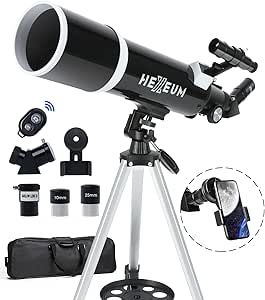


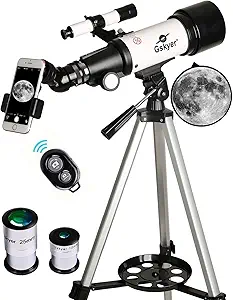
| stargazing telescopes for beginner | Aperture | Eyepieces | Focal Length |
|---|---|---|---|
| Celticbird 80mm Aperture 600mm | 80mm | 20mm and 9mm | 600mm |
| Koolpte Telescope for Adults & | 80mm | 25mm and 10mm | 600mm |
| Celestron AstroMaster 130EQ Te | 130mm | — | — |
| MEEZAA Telescope for Adults & | — | 25mm & 10mm | 500mm |
| Dianfan 90mm Aperture 800mm Re | — | — | 800mm |
| MEEZAA 90mm Aperture 800mm Ref | 90mm | 10mm and 25mm | 800mm |
| Celestron StarSense Explorer D | 130mm | 10mm and 25mm | — |
| Celestron StarSense Explorer L | 114mm | — | — |
| Telescope for Kids and Adults | 70mm | 6mm & 20mm | 300mm |
| Celestron Travel Scope 70mm Po | 70mm | 20mm and 10mm | — |
| Celestron AstroMaster 70AZ Ref | — | 20mm and 10mm | 700mm |
| Celestron StarSense Explorer L | 80mm | — | — |
| Celestron Travel Scope 80mm Te | 80mm | 20mm and 10mm | — |
| Telescope for Adults & Kids | 70mm | 20mm, 6mm with 3X Barlow | 300mm |
| Gskyer 70mm Aperture 400mm Ref | 70mm | — | 400mm |
More Details on Our Top Picks
Celticbird 80mm Aperture 600mm AZ Mount Refractor Telescope for Adults and Kids
This telescope stands out for its portability, making it a strong choice for families or casual observers who want to explore the night sky without heavy equipment. Compared to the Celestron AstroMaster 130EQ, it offers easier setup and lighter weight, though it sacrifices some aperture size and tracking stability. The included backpack, phone adapter, and filters make it versatile for quick outings but limit its use for serious, long-term astronomy. The adjustable tripod and simple manual focus facilitate beginner-friendly operation, yet the stability of the tripod may vary outdoors, especially in windy conditions. While it’s perfect for kids and beginners wanting a straightforward experience, it isn’t suited for advanced observing or astrophotography, which require sturdier mounts and higher magnification options.
Pros:- Lightweight and portable with backpack and accessories
- Suitable for both adults and children with adjustable tripod
- Includes versatile eyepieces and filters for various views
- Easy to assemble for beginner use
Cons:- Limited to basic magnification, not ideal for deep-sky objects
- Tripod stability can be affected by outdoor conditions
- Basic features may not satisfy advanced users
Best for: Families or casual stargazers seeking a portable, easy-to-transport telescope for quick moon and planet viewing.
Not ideal for: Serious amateur astronomers or those interested in astrophotography, due to limited magnification and mount stability.
- Aperture:80mm
- Focal Length:600mm
- Mount Type:AZ Mount
- Eyepieces:20mm and 9mm
- Magnification:30X and 66X
- Weight:5.8 pounds
Our verdict“This telescope makes the most sense for families or beginners prioritizing portability and ease of use over deep-sky capabilities.”
Koolpte Telescope for Adults & Beginners – 80mm Aperture, 600mm Focal Length, Fully Multi-Coated Optics, AZ Mount Tripod, Phone Adapter, Carrying Bag, Wireless Remote
This model is well-suited for those who want a straightforward, adaptable telescope with modern features. Unlike the MEEZAA 80mm Refractor, it offers a wireless remote and fully multi-coated optics for brighter images, making it a compelling choice for both daytime and nighttime viewing. The multiple eyepieces and included phone adapter support a range of magnifications, though the maximum magnification of 180X with a Barlow lens might overreach the telescope’s stability in windy conditions. Its portability, with a carrying bag and lightweight build, makes it ideal for outdoor adventures. However, the build quality can vary depending on handling, and the tripod may feel less sturdy for extended use. It’s best for beginners who want a tech-savvy, flexible telescope for casual astronomical viewing or visual observations.
Pros:- Easy to set up and use, with wireless remote control
- Includes multiple eyepieces and a phone adapter for versatile viewing
- Fully multi-coated optics for bright, clear images
- Portable with a carrying bag for outdoor use
Cons:- Limited stability of the tripod for heavy or extended use
- Magnification potential may be limited for detailed deep-sky viewing
- Build quality can depend on handling
Best for: Beginners and casual astronomy enthusiasts who value modern features like wireless remote control and multi-coated optics.
Not ideal for: Advanced amateur astronomers seeking high stability and deep-sky observing or astrophotography, as the mount and build are more basic.
- Aperture:80mm
- Focal Length:600mm
- Eyepieces:25mm and 10mm
- Magnification:24X and 60X (up to 180X with Barlow)
- Accessories:Phone adapter, wireless remote
- Weight:Lightweight
Our verdict“This pick makes the most sense for beginners who want a feature-rich, portable telescope for casual stargazing and daytime observations.”
Celestron AstroMaster 130EQ Telescope for Beginners
Compared with smaller refractors like the Celticbird 80mm, the Celestron AstroMaster 130EQ offers a larger aperture and an equatorial mount, which provides more detailed views of planets and lunar features, along with better tracking for stationary observations. While it’s heavier and more complex to set up than simpler telescopes, its stable German equatorial mount with slow-motion controls makes it ideal for those willing to learn basic astronomy techniques. The included accessories, such as the StarPointer finderscope and astronomy software, enhance the beginner experience. However, its weight and manual tracking may challenge absolute beginners without assistance, and it lacks astrophotography features. This telescope suits those who want to progress beyond basic moon and planet viewing while maintaining ease of use.
Pros:- Large 130mm aperture for brighter, more detailed images
- Stable, adjustable mount with slow-motion controls
- Quick, tool-free setup and transport
- Includes useful accessories and astronomy software
Cons:- Heavier and bulkier than smaller telescopes
- Manual tracking can be challenging for total beginners
- Limited to visual observation; no astrophotography support
Best for: Beginners eager to learn manual tracking and interested in planetary and lunar observation with room to grow into more advanced astronomy.
Not ideal for: Complete novices seeking ultralight, super-easy setups or those primarily interested in astrophotography, which it does not support.
- Aperture:130mm
- Mount Type:German equatorial
- Weight:17 lbs
- Included Accessories:20mm and 10mm eyepieces, StarPointer, software
- Assembly:Quick, tool-free
- Tripod Height:Fully adjustable
Our verdict“This telescope provides a solid balance of quality optics and beginner-friendly features for those ready to learn manual tracking and detailed viewing.”
MEEZAA Telescope for Adults & Kids, 80mm Aperture 500mm Refractor
This refractor offers a versatile option for families and casual observers, featuring an 80mm aperture and 500mm focal length that excel at moon, planet, and daytime nature viewing. Compared to the Koolpte 80mm, it includes a Barlow lens and colorful stickers, making it appealing for kids and outdoor outings. The altazimuth mount is straightforward to operate, and the waterproof backpack enhances portability. While its optics provide bright images, the limited focal length and manual focus may require patience for sharp images, especially for more detailed planetary views. The lack of detailed weight info and warranty details might concern some buyers. This telescope makes a good choice for family exploration and casual astronomy, although it’s less suitable for serious deep-sky pursuits.
Pros:- Suitable for both kids and adults, promoting family astronomy
- Includes accessories like Barlow lens and waterproof backpack
- Affordable, complete kit for easy setup
- Bright optics for moon and planet viewing
Cons:- Limited focal length reduces detailed planetary views
- Manual focus can be tricky for precise images
- Weight and warranty details are not specified
Best for: Families or beginners seeking a flexible, portable telescope for daytime and nighttime use, with a playful, easy-to-use design.
Not ideal for: Advanced astronomers or those wanting deep-sky astrophotography, as it’s more oriented toward casual observation and family fun.
- Objective Lens Diameter:80mm
- Focal Length:500mm
- Mount:Altazimuth
- Eyepieces:25mm & 10mm
- Magnification Range:20x-150x
- Accessories:Phone adapter, waterproof backpack, Barlow lens
Our verdict“This telescope is best for families and casual observers who want an easy, portable entry point into astronomy and outdoor exploration.”
Dianfan 90mm Aperture 800mm Refractor Telescope for Adults with Tripod & Phone Adapter
This refractor provides a step up in aperture size with 90mm and 800mm focal length, delivering bright, vivid images for general stargazing, birdwatching, and outdoor observation. Unlike the Celticbird 80mm, its larger aperture captures more light, making it more suitable for planetary details. The sturdy stainless steel tripod and included phone adapter support beginner and outdoor use, though manual focus might require fine adjustments to achieve sharp images. While its high zoom range (32×–240×) offers flexibility, the build quality of some accessories could be improved for more durability. It’s an excellent choice for outdoor enthusiasts wanting an all-around, portable telescope for varied uses, though it lacks advanced features for astrophotography.
Pros:- High-quality fully coated optics for bright images
- Portable and lightweight with sturdy tripod
- Includes phone adapter and carrying bag for outdoor use
- Suitable for both day and night viewing
Cons:- Manual focus may require some effort for clarity
- Magnification range might be limited for detailed deep-sky work
- Build quality of accessories could be better
Best for: Beginners and outdoor lovers who want a portable, high-quality optics system for versatile daytime and nighttime viewing.
Not ideal for: Advanced astronomers or those seeking long-exposure astrophotography, as it is primarily designed for visual observation and basic photography.
- Objective Lens Diameter:90mm
- Focal Length:800mm
- Mount:Altazimuth
- Focus Type:Manual
- Eyepiece:Kellner
- Weight:Approximately 4.7 kg
Our verdict“This telescope is ideal for outdoor enthusiasts who want a bright, portable optical system for general viewing and family adventures.”
MEEZAA 90mm Aperture 800mm Refractor Telescope for Adults
This high-powered refractor stands out for its large 90mm aperture, which delivers brighter, more detailed images compared to smaller models like the Telescope for Kids and Adults. The inclusion of multiple eyepieces, a Barlow lens, and a phone adapter makes it highly versatile for both visual observation and casual astrophotography. Its adjustable tripod ensures comfortable viewing angles, but setup may take longer than 10 minutes, which could frustrate eager beginners. While it offers impressive magnification up to 240X, this is limited for very advanced use, making it ideal for those who want quality without complexity. Compared to more basic models, this telescope offers a noticeable upgrade in brightness and detail, though it sacrifices some ease of use for more experienced hobbyists.
Pros:- Large 90mm aperture provides bright, sharp images
- Includes multiple eyepieces and a Barlow lens for flexible magnification
- Phone adapter enables easy photo and video capture
- Adjustable tripod for comfortable viewing angles
Cons:- Assembly can take longer than 10 minutes, which may deter some users
- Limited to a maximum of 240X magnification, not suitable for very detailed deep-sky observation
Best for: Beginners who want a powerful, versatile telescope that supports astrophotography and detailed viewing.
Not ideal for: Casual stargazers seeking quick, simple setups or those with very tight budgets, due to assembly time and higher cost.
- Aperture:90mm
- Focal Length:800mm
- Magnification:32X-240X
- Eyepieces:10mm and 25mm
- Barlow Lens:3X
- Tripod Height Range:28 to 46 inches
Our verdict“This telescope is perfect for beginners ready to explore in detail and try basic astrophotography, accepting some setup time for higher performance.”
Celestron StarSense Explorer DX 130AZ Smartphone Guided Newtonian Telescope
The Celestron StarSense Explorer DX 130AZ excels at making sky exploration accessible through its smartphone-guided technology, which sets it apart from the manual StarSense Explorer LT 114AZ. Its 130mm aperture offers bright views of planets, the Moon, and some deep-sky objects, making it ideal for beginners who want guided discovery. The smart technology simplifies star identification, but it depends heavily on a compatible smartphone, which could be limiting for some users. The manual altazimuth mount is straightforward but less stable for precise tracking, especially during longer sessions. Compared with the 114mm model, this telescope provides more light-gathering power for brighter images but requires a compatible device for full functionality. It’s best suited for casual astronomers eager for guided, illuminated views without complex setups.
Pros:- Smartphone-guided sky mapping simplifies locating objects
- Bright 130mm aperture offers vivid views of the Moon, planets, and bright deep-sky objects
- Includes two eyepieces and a sturdy tripod
- Intuitive interface for beginners
Cons:- Requires a compatible smartphone for full operation, which may limit some users
- Manual mount lacks motorized tracking, making long observation sessions more challenging
Best for: Beginners who want an easy, guided introduction to celestial viewing with a focus on bright objects.
Not ideal for: Users without compatible smartphones or those seeking a fully manual or motorized mount for detailed tracking.
- Aperture:130mm
- Type:Newtonian reflector
- Mount:Altazimuth manual
- Eyepieces:10mm and 25mm
- Compatibility:Android 12+, iOS 18+
- Warranty:2 years
Our verdict“This pick is ideal for beginners eager for guided, bright views and easy-to-use technology, accepting smartphone dependency and basic tracking limits.”
Celestron StarSense Explorer LT 114AZ Newtonian Smartphone Guided Telescope
The Celestron StarSense Explorer LT 114AZ offers a straightforward, beginner-friendly experience with its 114mm aperture and smartphone-guided sky recognition technology, making it easier to find planets, nebulae, and galaxies compared to purely manual setups like the Gskyer 70mm. Its simple altazimuth mount and the StarSense app streamline the process of locating celestial objects, though the manual tracking may require steady hands for best results. While it’s less powerful than larger models like the Celestron StarSense Explorer DX 130AZ, it remains a practical choice for casual viewing in darker skies. Its ease of setup and support make it a good starting point for those wanting guided exploration without overwhelming complexity, but it’s less suited for advanced or deep-sky astronomy.
Pros:- Smartphone-guided sky mapping simplifies object location
- Good 114mm aperture delivers bright, clear views of the Moon and planets
- Simple setup and lightweight design for portability
- Includes sky recognition technology for easier navigation
Cons:- Manual mount requires steady handling for precise tracking
- Limited to basic altazimuth mount, no motorization for tracking objects automatically
Best for: Beginner stargazers interested in easy sky mapping and viewing brighter objects without complicated equipment.
Not ideal for: Users seeking motorized tracking or advanced deep-sky astrophotography, as its manual mount and limited power may fall short.
- Aperture:114mm
- Type:Newtonian reflector
- Mount:Altazimuth
- Included Technology:StarSense Explorer app
- Warranty:2-year US warranty
Our verdict“This telescope suits beginners who want guided, bright views with minimal setup, though it lacks advanced tracking features.”
Telescope for Kids and Adults, 70mm Aperture Refracting Telescope with 15X-150X Magnification
This 70mm refractor is a flexible option for families and beginners, offering a wide magnification range from 15X to 150X, which allows for lunar, planetary, and terrestrial viewing. Its lightweight, portable design and included phone adapter make outdoor observation accessible for kids and adults alike, though the inverted image in the finderscope may require initial adjustment. Compared with the Celestron Travel Scope 70mm, it provides more variable magnification options, making it more versatile for different observing scenarios. However, its basic optics and potential for atmospheric distortion at higher magnifications limit its use for serious astronomy. This telescope makes the most sense for those looking for a multi-purpose beginner scope that can be used both in the backyard and on outdoor adventures.
Pros:- Easy to assemble without tools, suitable for kids and beginners
- Wide magnification range supports lunar, planetary, and terrestrial viewing
- Includes phone adapter and remote for easy photo capturing
- Portable lightweight design
Cons:- Inverted image in finderscope can be confusing initially
- Optics are basic and less effective under light-polluted or atmospheric conditions
Best for: Families or beginner individuals seeking an affordable, versatile telescope for lunar, planetary, and scenic viewing.
Not ideal for: Advanced amateur astronomers or those focused on deep-sky astrophotography, due to its basic optics and limited stability at high magnifications.
- Aperture:70mm
- Focal Length:300mm
- Magnification:15X-150X
- Eyepieces:6mm & 20mm
- Barlow Lens:3X
- Finderscope:5×24
Our verdict“This telescope offers a versatile, family-friendly experience with decent magnification options, ideal for casual observing and outdoor adventures.”
Celestron Travel Scope 70mm Portable Refractor Telescope with Backpack
The Celestron Travel Scope 70mm is a compact, lightweight choice that emphasizes portability, making it perfect for outdoor families and casual observers. Its fully coated glass optics and included accessories—two eyepieces, a star diagonal, and a sturdy tripod—allow for quick setup and versatile viewing of daytime landscapes and nighttime celestial objects. Compared with larger or more feature-rich models like the MEEZAA 90mm, it sacrifices some light-gathering power for convenience, which limits its deep-sky capabilities. The included software adds educational value, but the build quality is more basic, reflecting its focus on travel. This telescope is best suited for those who prioritize ease of transport and simple operation over high-power or deep-sky observing.
Pros:- Lightweight and compact, ideal for travel and outdoor activities
- No-tool setup for quick assembly
- Includes backpack, accessories, and software for added value
- Suitable for daytime scenic viewing and basic night sky observing
Cons:- Limited light-gathering power restricts deep-sky observation
- Basic optics and build quality are less durable for frequent use
Best for: Beginners and families seeking an ultra-portable telescope for casual daytime and nighttime use, especially on trips.
Not ideal for: Experienced astronomers or those wanting detailed deep-sky views, given its smaller aperture and basic build quality.
- Aperture:70mm
- Optics:Fully coated glass lenses
- Eyepieces:20mm and 10mm
- Tripod:Full-height
- Included accessories:Backpack, finderscope, star diagonal, software
Our verdict“This telescope excels for travelers and casual stargazers who value portability over deep-sky performance, accepting its simplicity and limited power.”
Celestron AstroMaster 70AZ Refractor Telescope for Moon & Planet Viewing
The Celestron AstroMaster 70AZ stands out for its ease of use and adaptability, making it a solid choice for newcomers interested in both celestial and terrestrial viewing. Its 70mm fully coated achromatic lens provides clear, crisp images, and the intuitive alt-azimuth mount allows straightforward navigation of the sky, unlike the more advanced mounts that require extra skill. Compared to the Celestron StarSense Explorer LT 80AZ, it lacks smartphone-guided technology but offers more stable manual control, which some beginners prefer. Its lightweight design and included accessories make setup quick, but the basic magnification limits detailed planetary or deep-sky observation. This pick makes the most sense for beginners wanting a reliable, all-around starter telescope that’s easy to operate and transport.
Pros:- Easy to assemble and operate, ideal for beginners
- Versatile for night sky and terrestrial use
- Includes essential accessories and astronomy software
Cons:- Limited to basic magnification levels
- Manual mount requires steady handling for tracking objects
Best for: Beginners who want an easy-to-assemble, versatile telescope for both astronomy and land viewing
Not ideal for: Advanced users or those seeking high-magnification astrophotography capabilities
- Optical Diameter:70mm
- Focal Length:700mm
- Eyepieces:20mm and 10mm
- Magnification:45x and 90x
- Mount Type:Alt-azimuth
- Tripod:Adjustable full-height tripod
Our verdict“This telescope is best for beginners seeking a reliable, straightforward introduction to astronomy with versatile viewing options.”
Celestron StarSense Explorer LT 80AZ Smartphone Guided Refractor Telescope
The Celestron StarSense Explorer LT 80AZ makes sky discovery accessible through its smartphone-guided technology, simplifying object location for beginners. Its 80mm aperture delivers bright, sharp views of the Moon and planets, comparable to the Celestron AstroMaster 70AZ, but with the added convenience of StarSense’s sky map app. Unlike the AstroMaster’s manual control, this model’s smartphone interface helps overcome the learning curve of locating celestial objects. However, the manual alt-azimuth mount offers basic tracking, which can be less precise over extended observations. Its simplicity and support make it ideal for beginners eager to combine their phone’s capabilities with astronomy, though urban light pollution might limit deep-sky viewing.
Pros:- Smartphone-guided sky navigation simplifies locating objects
- High-quality 80mm aperture for vivid views
- Easy setup and smooth manual tracking
Cons:- Limited to basic alt-azimuth mount without motorized tracking
- Performance affected by light pollution in urban areas
Best for: Beginner stargazers who want guided object location via smartphone app
Not ideal for: Experienced astronomers wanting motorized tracking or astrophotography
- Aperture:80mm
- Mount Type:Altazimuth
- Included Accessories:Smartphone adapter, StarSense Explorer app
- Warranty:2 years
Our verdict“Ideal for beginners who prefer guided sky exploration with their smartphone but do not need motorized tracking.”
Celestron Travel Scope 80mm Telescope Kit with Backpack and Smartphone Adapter
The Celestron Travel Scope 80mm offers portability and ease of use, making it a top choice for families or those who travel frequently. Its compact design and included backpack allow for quick setup at outdoor outings, similar to the Gskyer 70mm Refracting Telescope, but with a larger aperture for brighter images. While its lightweight build favors transport, this can compromise stability during use, especially on uneven surfaces. The set includes multiple eyepieces and a smartphone adapter, providing versatile viewing options for terrestrial and celestial subjects. However, it’s more suited for casual observing rather than detailed deep-sky or planetary work.
Pros:- Portable with a convenient backpack for travel
- Easy setup suitable for beginners and families
- Includes multiple eyepieces and accessories for versatility
Cons:- Limited stability due to lightweight design
- Not suitable for advanced or high-magnification astronomy
Best for: Families and travelers looking for a lightweight, versatile telescope for casual viewing
Not ideal for: Serious amateur astronomers seeking advanced features or high stability
- Aperture:80mm
- Eyepieces:20mm and 10mm
- Tripod:Full-height tripod
- Accessories:Smartphone adapter, finderscope, star diagonal, software
Our verdict“Perfect for casual, on-the-go stargazing and terrestrial observation for families or travelers.”
Telescope for Adults & Kids, 70MM Aperture FMC Optics, 300MM Refractor, 15X-150X Magnification with Phone Adapter and Tripod
This 70mm refractor offers a broad magnification range, from 15x up to 150x, making it suitable for both terrestrial and celestial observation. Its fully multi-coated optics provide clear images, comparable to the Gskyer 70mm but with more flexible magnification options. The inclusion of a phone adapter and wireless remote simplifies capturing photos, appealing to families and young explorers. However, the lightweight design and lack of motorized tracking mean it’s less suited for detailed planetary observation or extended sky sessions. It’s a solid choice for casual users wanting versatile viewing and easy photo capture, but not for those pursuing serious astrophotography.
Pros:- Wide magnification range for terrestrial and celestial viewing
- Includes phone adapter and wireless remote for easy photo capturing
- Suitable for both kids and adults
Cons:- No motorized tracking limits long observation sessions
- Lightweight build may affect stability during use
Best for: Families or individuals seeking a versatile, easy-to-use telescope for both outdoor adventures and casual astronomy
Not ideal for: Advanced astronomers or those needing stable, high-precision tracking for astrophotography
- Aperture:70mm
- Focal Length:300mm
- Magnification:15X-150X
- Eyepieces:20mm, 6mm with 3X Barlow
- Finderscope:5×24
- Tripod:Yes
Our verdict“A flexible, family-friendly telescope ideal for casual stargazing and outdoor exploration with simple photo capabilities.”
Gskyer 70mm Aperture 400mm Refracting Telescope for Beginners with Carry Bag, Phone Adapter, and Wireless Remote
The Gskyer 70mm excels as a lightweight, travel-ready telescope designed for beginner and young astronomers. Its 400mm focal length offers variable magnification with included eyepieces and a Barlow lens, providing flexibility for different viewing needs. The fully coated optics deliver crisp images, and the adjustable aluminum tripod ensures easy setup in various outdoor settings. It’s comparable to the Celestron Travel Scope 80mm but with a slightly shorter focal length, which can limit high-magnification viewing. The included carry bag and wireless remote make it a practical choice for quick outings, though stability might suffer on uneven ground. It’s well-suited for casual stargazing and outdoor adventures, especially for those prioritizing portability.
Pros:- Portable with a convenient carry bag for travel
- Includes multiple eyepieces and Barlow lens for versatile magnification
- Wireless remote for easy operation
Cons:- Magnification may be limited for detailed astronomical work
- Requires some assembly and alignment for optimal results
Best for: Beginners and kids who want a portable, easy-to-carry telescope for outdoor use and basic astronomy
Not ideal for: Serious astronomers seeking high stability or deep-sky imaging
- Aperture:70mm
- Focal Length:400mm
- Magnification:Variable with eyepieces and Barlow
- Finder Scope:5×24
- Tripod:Adjustable aluminum alloy
- Includes:Carry bag, phone adapter, wireless remote
Our verdict“An excellent choice for beginner travelers and outdoor explorers who want quick and easy stargazing on the go.”

How We Picked
In selecting these telescopes, I focused on factors that matter most to beginners: ease of use, optical quality, build durability, and portability. Products were evaluated based on user-friendly features like simple mounting systems and intuitive aiming, as well as optical specifications that deliver satisfying views of the moon, planets, and some deep-sky objects. Cost-effectiveness was also key, ensuring options offered good value without sacrificing essential performance. The ranking reflects a balance between affordability, quality, and features that help new astronomers enjoy their first experiences under the night sky.Factors to Consider When Choosing Stargazing Telescopes For Beginners
Choosing the right telescope as a beginner involves understanding several key factors. While many models look similar, differences in features like aperture size, mount type, and included accessories can significantly impact your enjoyment and learning curve. It’s also important to consider how much setup time you’re willing to handle and whether portability matters for your stargazing plans. Being aware of common pitfalls—such as overly complicated mounts or underpowered optics—helps ensure you select a telescope that truly suits your needs. Here are some critical considerations to keep in mind.Aperture Size and Optical Quality
The aperture, or the diameter of the telescope’s main lens or mirror, directly influences the brightness and detail of the images you see. For beginners, an aperture of 70-80mm strikes a good balance between performance and portability, allowing clear views of the moon and visible planets. Larger apertures, like 90mm or 130mm, reveal more distant objects but often come with increased size and cost. Opt for models with multi-coated optics, which improve light transmission and image clarity, especially in low-light conditions.
Mount Type and Ease of Use
The mount stabilizes the telescope and helps in locating objects. Altazimuth mounts are simple to operate, moving vertically and horizontally, making them ideal for beginners. Equatorial mounts, while more precise for tracking celestial objects, can be more complex to set up and understand. For new stargazers, a sturdy, easy-to-adjust altazimuth mount minimizes frustration and speeds up learning. Consider models with slow-motion controls for fine adjustments to improve viewing accuracy.
Portability and Size
If you plan to take your telescope to different locations, portability becomes a major factor. Compact models like the Travel Scope or smaller refractors are lightweight and easy to carry, but may sacrifice some optical power. Larger telescopes offer better views but are bulkier and harder to transport. Think about where you’ll use the telescope most—if it’s primarily at home, size may be less critical, but for on-the-go stargazing, a portable design is essential.
Included Accessories and Features
Many beginner telescopes come with extras like smartphone adapters, remote controls, or carrying cases, which add convenience. Smartphone-guided models can greatly simplify star-hopping and object identification, making them a good choice for those new to astronomy. However, be cautious of models with too many accessories that may complicate setup or operation. Prioritize telescopes that include high-quality eyepieces and sturdy tripods to maximize your initial experience.
Budget and Long-term Value
While it can be tempting to choose the cheapest option, investing a little more often results in a more satisfying experience and longer-lasting equipment. Cheaper models may lack stability, optical clarity, or durability, leading to frustration. Conversely, very high-end telescopes might be overwhelming for a beginner, especially if they are complex to operate. Aim for a model that offers a good compromise between cost and performance, ensuring you can grow into your telescope over time.
Frequently Asked Questions
Can I see planets clearly with a beginner telescope?
Yes, most beginner telescopes with an aperture of 70-80mm can show planets like Jupiter, Saturn, and Mars distinctly. While they won’t reveal the fine details seen by advanced equipment, these telescopes will display the rings of Saturn, the moons of Jupiter, and the polar caps of Mars. The key is to use appropriate eyepieces and ensure the telescope is well-collimated and stable. Patience and steady viewing conditions also improve the clarity of planetary images for beginners.
Is a smartphone-guided telescope better for beginners?
Smartphone-guided telescopes can be a significant advantage for newcomers, as they simplify the process of locating objects in the night sky. These models often include apps that help you find planets, stars, and other celestial bodies with minimal prior knowledge. However, they may rely on electronic components that need batteries or firmware updates, and their accuracy can vary. If ease of use and quick results matter most, a smartphone-guided model is worth considering, but it’s still beneficial to learn basic star-hopping techniques.
How much should I spend on my first telescope?
Beginners can find good quality telescopes in the $100-$300 range. Spending within this bracket typically provides models with adequate optical quality, stable mounts, and helpful features like smartphone adapters. Stretching beyond $300 might offer better optics and durability but can also introduce unnecessary complexity for a first-time user. Focus on finding a balance that offers reliable performance without overwhelming features, so you can enjoy learning without frustration.
What features are most important for a beginner to avoid missing out?
The most vital features for beginners include a user-friendly mount, a stable tripod, and clear instructions for setup. Avoid models that require extensive assembly or have overly complex controls, as these can hinder initial enjoyment. Multi-coated optics and good-quality eyepieces enhance the viewing experience, so prioritize those. Additionally, a lightweight, portable design allows for easier transport and spontaneous stargazing sessions, ensuring your early experiences are positive and inspiring.
Should I upgrade my telescope later or stick with a beginner model?
Many beginners find that their first telescope suits their initial needs, but as skills improve, upgrading can open new possibilities for deep-sky viewing and detailed planetary observation. Starting with a versatile, slightly higher-quality model can provide a smoother transition into more advanced astronomy. However, if you enjoy casual stargazing and learning the basics, a well-chosen beginner telescope can serve you well for years. It’s wise to select a model with upgrade paths or accessories that allow for growth without immediate replacement.
Conclusion
For those just starting out, the Celestron AstroMaster 70AZ offers an excellent blend of simplicity, quality, and value, making it the best overall choice. If portability and ease of setup are your priorities, the Celestron Travel Scope 70mm makes a compelling option. Budget-conscious beginners will appreciate the Koolpte Telescope for its versatility and features at an accessible price. More experienced newcomers or those willing to invest in a longer-term tool should consider models with smartphone guidance or larger apertures, like the Celestron StarSense Explorer DX 130AZ. Tailoring your choice to your specific needs and expectations will ensure a rewarding start in your stargazing adventure.
As an affiliate, we earn on qualifying purchases.Halloween Picks
halloween